Initial Test Run
At its simplest, an engine requires fuel, air, compression and ignition to run.
As we now have the sensors and outputs working, as well as confirmed ignition events at the right times for the cylinders, the next step is to add fuel and air to the mix, and hopefully establish a basic, running engine. Compression of course is given by the engines physical design (and condition) - if you don’t have compression, you don’t have an engine that will ever run!
In general the the only way to add air to the engine is via the throttle, or, if fitted, an idle air control valve.
To begin with, ignore idle air control, disconnect the electrical connection to the valve if possible, and instead, allow a small amount of air by physically ‘jacking’ the throttle open approx 3-5% (or open the idle bypass screws if applicable). This allows enough air for the engine such that it should run and idle (albeit high).
With the throttle ‘jacked’ open, the air part of the engine's requirements to run are met - the next step is fuel.
Before, when testing for RPM Sync, we disabled fuel injection events - head back to the System>Injection Driver and, instead, set the fuelling to ‘Batch’. This will fire all injectors at the same time, and while we can look at paired and sequential injection later, this simple form of injection will be enough to get running (and indeed most early 90s engines used batch injection full time.)
An in-depth explanation of how the final Fuel Pulse Width (the time in milliseconds the injector is fired for each cycle) is derived can be found later in the manual, however for now, it is worth noting what we should expect to see when cranking.
For this part, open the ‘Mapping’ Tab in MEITE, as shown below:
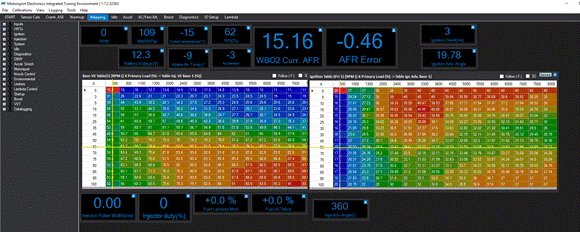
Here we can see the Injector Pulse Width DRO in the lower left (which is reading zero in this example due to there being no RPM input).
If you have already loaded a suitable basemap, and configured your engine specifics, including injector size in the System>Engine Driver and System>Injection driver, then carry out a quick sanity check of all of the sensor readings, and if everything checks out, crank the engine.
Immediately you should see a stable RPM reading, as well as the Injector Pulse Width reading. This number will vary depending on engine size, injector size and temperature, however, typically 10-20mS is typical for a cold engine, with 2-6mS typical for a warm engine.
If the engine springs to life, (it may be idling high/low etc) then you have won the most part of the battle, and you can continue on with tuning, however, of not, there are some symptoms and possible fixes (as a get you running fix) listed in the "non-start Diagnosis" section of Troubleshooting.