Startup and Return to Idle Setup
The ME's idle control system offers OEM type flexibility in terms of idle start flair and return to idle stabilisation.
The below applies to closed loop idle modes:
Startup
When the engine starts, the idle duty is set to the current setting in the Open Loop Idle Table at the current temperature (even in closed loop this happens, so its important to tune your open-loop idle table firs) plus the CL Start Inc (%).
It will be driven at this duty until the engine RPM goes over the Cranking Max RPM (typically 400) defined in the Startup>Startup Settings. Then idle will go into normal mode after the CL Start Delay time (below its set to 6 seconds)/
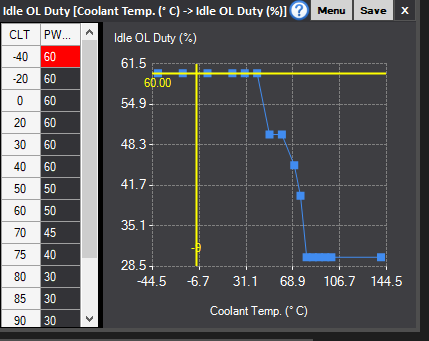
For example lets assume the engine is at 30 degrees. You can see below the OL (Open Loop) Duty table would be commanding 60% to the valve. The CL Start Inc setting is 15%, so the valve will be driven at 75%. Note if the PWM Max is 70%, then it will be clamped to 70%.

Return to Idle
When the engine falls from a higher RPM back into idle conditions (such as when the driver comes to a stop with the clutch depressed) then the idle mode will go to RTI (Return to Idle). Like the start-up, the CL RTI Inc will add onto the OL table value at the current engine temperature, and hold that duty for the time set in CL RTI Delay(s).
In the above example, lets now assume the engine is warm at 90* (and as a result the OL table commands 30% idle duty) then as soon as the idle conditions are met, the idle valve will be driven at 35% (30% from OL table plus 5% from the CL RTI Inc setting) for 1 second.
Tuning these values are usually best left to an expert in tuning. Essentially, RTI should be set so the engine doesn't "hang" for too long as it approaches idle, but not too short that the idle is unstable and the engine "dips" to a low RPM.
Start-up flair is really down to users choice. A high flair will result in an easier to start engine, but may sound a bit "amateur" - a balance is always attainable however, and it will act OEM once tuned correctly.