Triggering Setup/Crank/Cam Sensors
Before we crank the engine, refer to the section above on setting the trigger types for both crank and cam(s). Again, note that you do not need to run a cam sensor if you wish to run in batch/paired injection, but for OEM triggers such as the MX-5/Subaru etc, you must use the correct Cam settings.
When using a Plug-In ECU, the base-maps for your model will have the crank, cam and timing offset details already set, so ALWAYS load one of them first!
Triggering concerns the ECU being able to accurately measure the current speed and position of the engine. You can use either VR or Hall-Effect sensors for this, and the ME ECU supports a range of OEM and standard trigger patterns.
Usually, a wheel with either a missing tooth, or specific pattern (or a sync tooth on the cam) is mounted on the engines front pulley or cast into the flywheel. A sensor reads this and the ECU can then determine the engines current position and RPM.
If you only use a crank position sensor, the ECU can only be sure of the engines angle over a 360* cycle (there are two complete cycles in a four-stroke engine as a piston can be at the top either about to go 'bang' or just finishing pushing out exhaust gasses) - so it will only be able to run fuelling semi-sequentially and run ignition in a wasted-spark configuration. If you add a cam sensor, then the ECU can correctly determine phase, giving a full 720* angle of the 4-stroke cycle, so fully-sequential fuel and ignition (COPs) can be utilised.
Some images below are sourced from the internet.
Below are a few examples of trigger arrangements:
An after-market 36-1 trigger wheel and sensor fitted to the engines front pulley (AR Engineering):

This is an OEM Vauxhall crankshaft. Note the big "gear" which is in fact a 60-2 trigger wheel mounted directly to the crank:

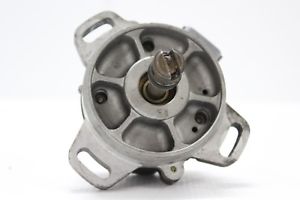
Some engines use purely cam position to determine engine position, such as the RB range of Nissan Engines (This is mounted at the front of the engine and the centre shaft is turned by the cam-belt sprocket):